More testing before prostate biopsy just makes sense
Volume 14, Issue 4 | July 30, 2026


ALSO IN THIS ISSUE
Do new Alzheimer’s drug results mean pTau217 tests are worth it?
One at-home test to rule them all?
Infectious disease update: Cyclospora, ebola, measles

Do new Alzheimer’s drug results mean pTau217 tests are worth it?
Blood tests for pTau217 are now the diagnostic of choice for detecting early Alzheimer’s disease (see our April review and this July 2026 report). However, until recently, the clinical rationale for early Alzheimer’s diagnosis was limited. Yes, it permitted patients and their caregivers to plan ahead (and researchers to focus clinical trials). But testing really pays off when it enables effective therapies to be matched to the patients who can benefit. And even though we now have two FDA-approved drugs for Alzheimer’s, it wasn’t at all clear that they were truly effective.
The two drugs are definitely good at one thing: eliminating beta-amyloid plaques. However, they only demonstrated minor (largely imperceptible) cognitive benefits. Research showed that Lecanemab (Leqembi®) slowed decline by 26 - 27%, and Donanemab (Kisunla®) by 29 - 35%. That translates to at best just a six-month delay in progression, while 21 - 37% of patients experienced excess fluid in the brain (ARIA) requiring treatment suspension.
But all that data came from clinical trials. In 2023, the LEADER study began tracking Lecanemab’s effectiveness in a more real-world environment (i.e., generally older, with more comorbidities). At July’s Alzheimer’s Association International Conference, the drug’s manufacturer (Biogen/Eisai) reported interim results that are much more promising. After 17 months, 83% of 432 patients benefitted from treatment (75.9% were “stable,” while 6.6% improved), while ARIA occurred in only 12.3%.
COMMENTARY: With such strong results, why do we keep “work” in quotes? We are always cautious with interim manufacturer-reported data. In this case, no placebo group was reported, and diagnostic “stability” is neither a precise nor very demanding term. In this context, it means that a patient didn’t change major categories in the Clinical Dementia Rating – Sum of Boxes diagnostic (CDR-SB). The boundaries of those categories are quite wide, especially once symptoms beyond “mild” are apparent.
More testing before prostate biopsy just makes sense
After the FDA approved prostate specific antigen (PSA) testing for screening in 1994, deaths from prostate cancer declined by 50%. Definitely a great achievement. The problem is that PSA has a very low positive predictive value — only about 13% of PSA-positive (>3ng/ml) men develop clinically significant prostate cancer, so lots of men get unnecessarily referred to biopsy.
MRI helps in the diagnostic journey because it reveals potentially cancerous changes in the size, shape, and structure of the prostate. But just like PSA, on its own it has limited ability to distinguish malignant from benign changes. A recent report shows that traditional digital rectal examination and MRI are about equally effective when it comes to identifying aggressive cases with poor outcomes.
A lot of effort is being and has been directed at improving the prostate diagnostic pathway. A recent report evaluates a multi-component diagnostic pathway that includes PSA, plasma protein biomarkers, genetic risk profile, and MRI, plus clinical presentation. It missed far fewer cancer cases than PSA alone (false negatives reduced from 26% to 10%), although false positives were about the same.
COMMENTARY: Clearly pre-biopsy diagnostics make sense. MRI is part of the solution, so the question is which of the available supplementary tests should go with it. While we have no head-to-head comparisons to guide our choices — Which heritable mutations should we be looking for? Which plasma proteins? — any one of these may be capable of improving outcomes. We hope and expect to hear more about these multi-omic tests.

One at-home test to rule them all?
During the pandemic, we all got used to the idea of at-home testing for COVID. Since the end of the pandemic, we have seen FDA approvals for at-home tests or at-home sampling for infections that range from the flu to HPV, chlamydia, gonorrhea, trichomoniasis, and syphilis.
Are we ready, then, for a single at-home testing unit that can diagnose all sorts of things, from infectious diseases to . . . cancer?
That’s the eventual goal for the lead author of a recent paper describing such a device. Fundamentally, the tool is a fluorescent-light detector. That’s useful because there are several laboratory techniques that use the presence, absence, or strength of fluorescent light to distinguish between positive and negative test results (RT-LAMP, RPA, CRISPR / Cas, and TRAP). According to the paper, this test unit is compatible with all of them.
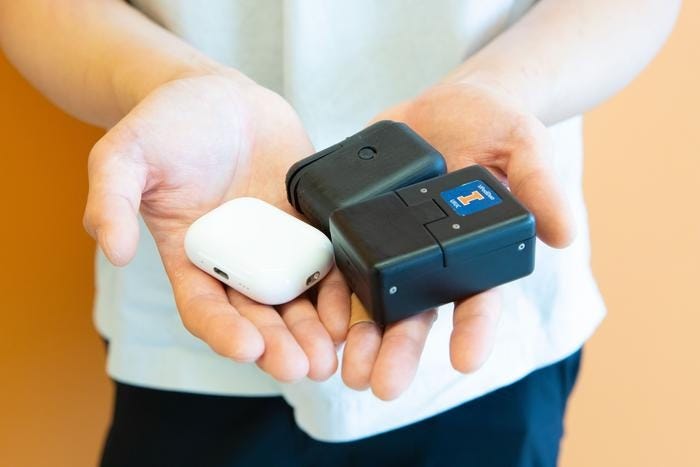
So how small is this thing? The original version, which could only measure one sample at a time, is roughly the size and shape as an AirPods case (see photo — the white object is an AirPods case, and the device is the black rectangular item in the back). The newer version of the tool, which can measure a test sample and a control sample simultaneously, is a little bigger (it’s the black rectangular item in the front).
COMMENTARY: Cancer testing at home seems like maybe not the best idea — if there was ever a test result that needed to be accompanied by a clinician’s immediate advice, it would be that one. But the idea of a multitasking tool that could diagnose a variety of less consequential ailments and / or monitor chronic disease patients is intriguing.
That said, we also remember the home PCR units that appeared during the COVID era. While those promised more reliable results than the rapid antigen tests we all got used to, the price point for both the testing device itself and the individual test cartridges was much too high for most people at home, and even for many physicians’ offices. If this thing is aiming to be the killer app for at-home diagnostics, both the tool and its consumables need to be affordable for everyone.

Cyclospora
The outbreak of the month is an unusually unpleasant one. We won’t go into the symptoms, as we’re sure you’ve heard more than enough about that already. So what do you need to know about cyclospora from a diagnostic perspective?
The big deal about cyclospora, diagnostically speaking, is that it’s hard to test for it, both in people and on produce.
Testing in people
The parasite doesn’t take up stain well, so it’s hard to see under a microscope. It isn’t included on standard GI-disease test panels, so clinicians have to order PCR tests — which, as we all know, can take a while.
Testing produce
It takes very little cyclospora to make people sick. It also can’t be cultured in a lab. The combination of these two factors means that labs can’t just swab a head of lettuce to see if it’s contaminated — if you don’t swab the right spot, you could get a false negative.
Instead, labs have to wash produce carefully to try to dislodge the parasite (which itself isn’t easy, because the little buggers are tenacious), separate out the debris from the liquid, and then run PCR on the debris.
Challenging epidemiology
The other difficulty with cyclospora is that after you eat contaminated food, it can take up to 10 days before symptoms appear. Good luck remembering what you ate that long ago.
As we write, the FDA is investigating four different cyclospora outbreaks, including the enormous one potentially linked to iceberg lettuce from Taylor Farms de Mexico. Our advice? If you have the option, buy produce grown near you. According to Your Local Epidemiologist, “there has never been a documented cyclosporiasis outbreak linked to a local farm.”
Ebola Bundibugyo
On July 2, the WHO granted its first emergency use listing (EUL) for a molecular test that detects the Bundibugyo species of Ebola — the one causing the current large outbreak in the Democratic Republic of Congo. On July 22, the FDA granted the first emergency use authorization (EUA) of a test for that purpose.
The two tests are made by different companies — the WHO-approved test comes from a Chinese company, while the FDA-approved test comes from a firm in the US.
As of July 28, the DRC has reported 2,423 confirmed cases and 967 deaths, for a case fatality ratio of roughly 40%.
Measles
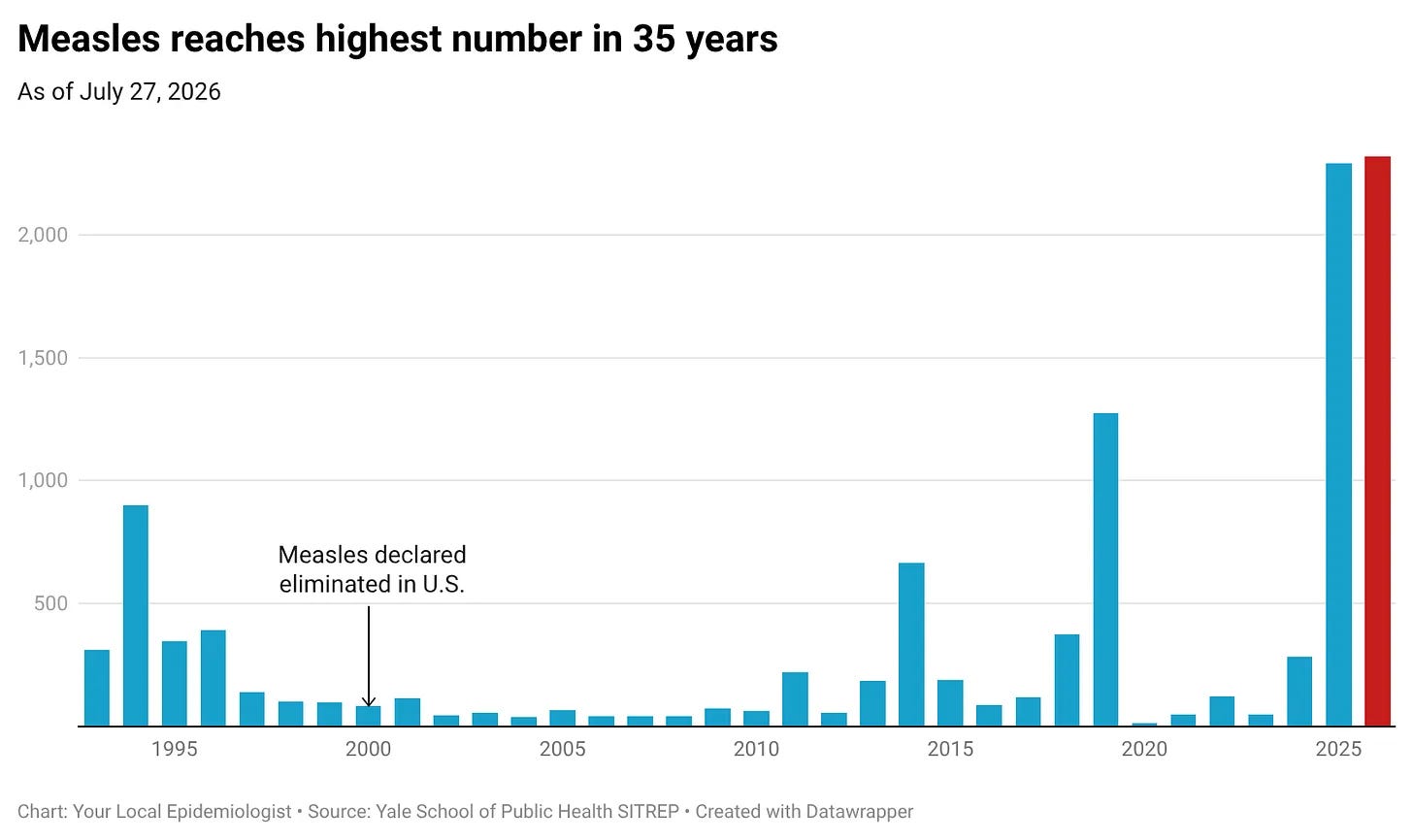
The total number of measles cases in the US this year has topped 2025’s record-breaking total, and it’s only July. Due mostly to the ongoing outbreak in Utah and the now-ended one in South Carolina, we’re now at 2,318 official cases, the most in 35 years.
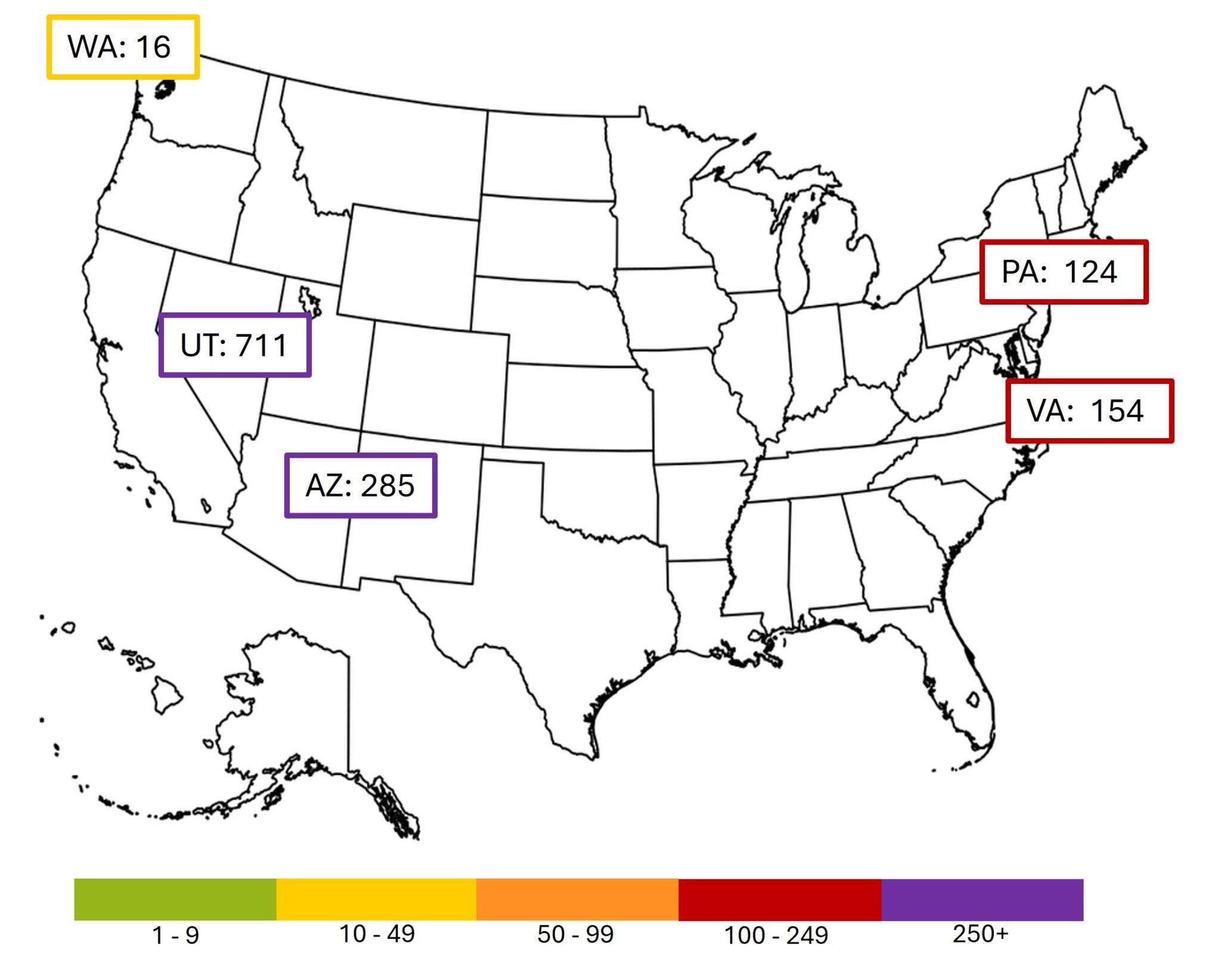
The current larger outbreaks in the US are shown below: Arizona / Utah, Pennsylvania, Virginia, Washington.